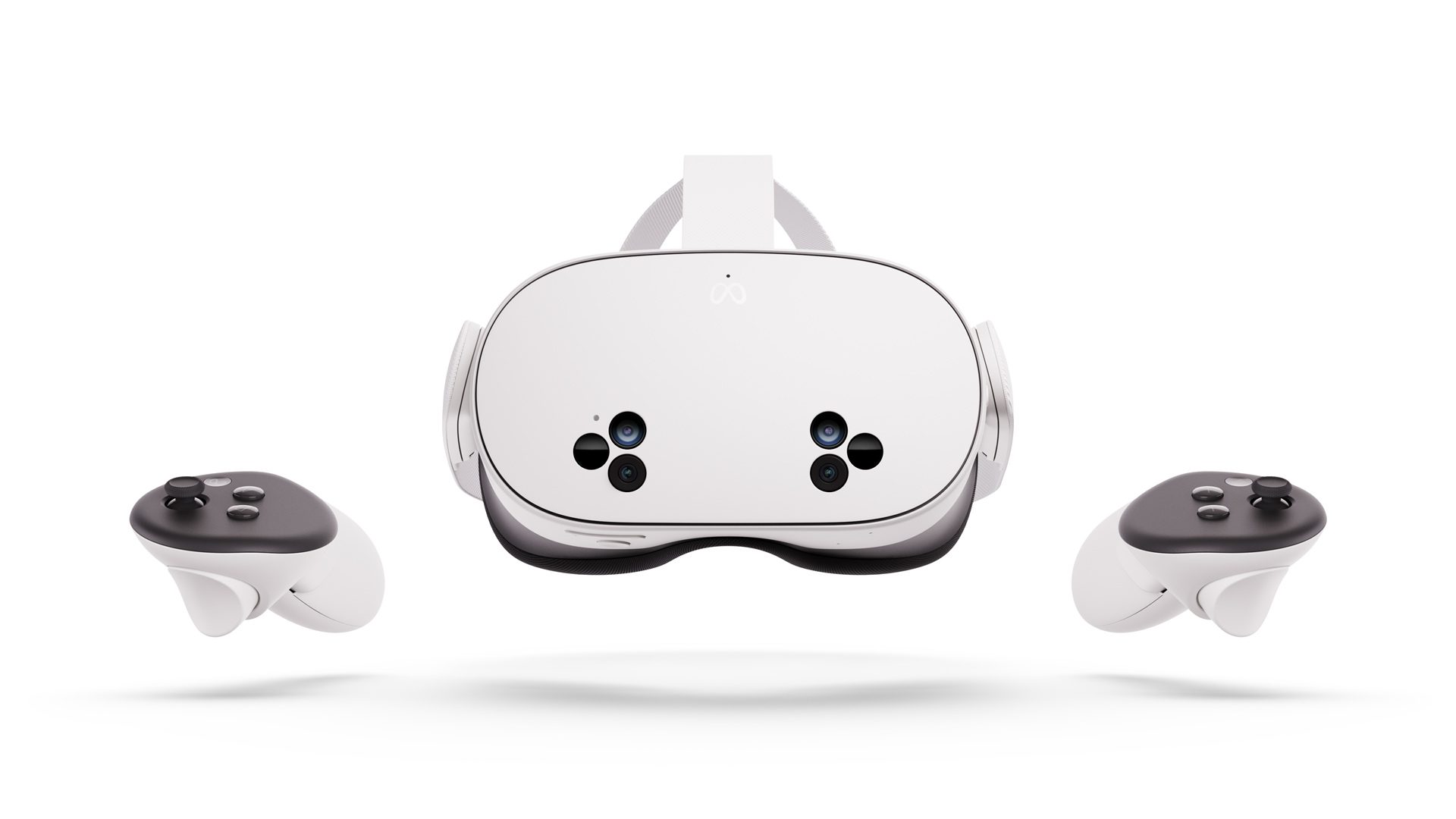
After a torrent of leaks, Meta has finally unveiled Quest 3S at Connect today, detailing every reason why it thinks Quest and Quest 2 owners ought to upgrade to the company’s latest and now most affordable mixed reality headset. Here’s the breakdown:
In terms of specs, Quest 3S is straddling somewhere between the 2020-era Quest 2 and 2023-era Quest 3, notably ditching the monochrome passthrough and last-gen Qualcomm Snapdragon XR2 chipset for full-color sensors and the same Snapdragon XR2 Gen 2 as Quest 3.
Note: If you’re looking for the long of it, make sure to check out our hands-on to find out more about Quest 3S and what sets it apart from the Quest lineup.
For the side-by-side spec sheet, scroll down to the bottom of the article.
As you’d imagine, running the same chipset and offering color passthrough will give users access not only to the back catalogue of Quest titles, but also mixed reality games and exclusives designed for Quest 3 moving forward.
To hit that magical $300 price point (128GB model) though, it’s relying on older Fresnel lenses as well as a the same resolution displays as Quest 2. At least in terms of resolution, the gulf between Quest 2 and Quest 3 isn’t that wide, so it’s a pretty understandable holdover.
That means we’re again seeing some flavor of 1,832 × 1,920 (20ppd) LCD display with a 96-degree horizonal field of view (FOV), as seen on sheet below. By comparison, Quest 3 boasts dual 2,064 × 2,208 (4.5MP) LCD displays, a newer pancake lens design and 110-degree horizontal FOV.
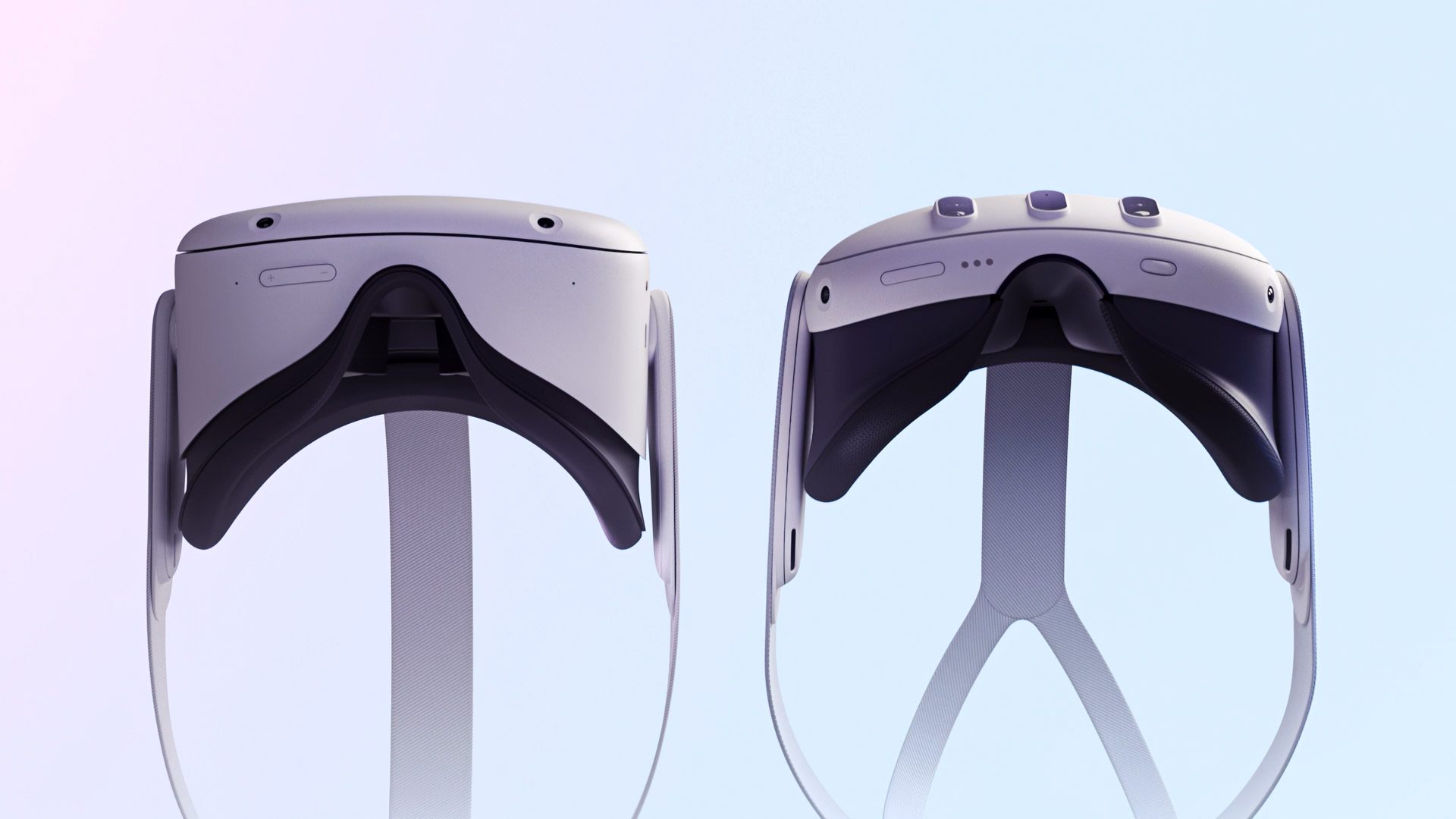
Quest 2 (left) and Quest 3 (right) | Image courtesy Meta
With facial interfaces removed, Meta is trumpeting Quest 3S as “20 percent slimmer” than Quest 2, where as the claim for Quest 3 is 30 percent slimmer, owing to its inclusion of pancake lenses.
Strangely enough, Quest 3S is launching with the same storage options as Quest 2: 128GB and 256GB—something deemed too small for Quest 3 proper, which is discontinuing its 128GB version, leaving only the 512GB to choose from. Yeah, pricing as and availability for older models has changed a bit. Check out our full explainer on what’s staying and what’s going to learn more.
Quest 2
Quest 3S
Quest 3
Visuals
Display
1 × LCD
1 × LCD
2 × LCD
Resolution (per-eye)
1,832 × 1,920 (3.5MP)
1,832 × 1,920 (3.5MP)
2,064 × 2,208 (4.5MP)
Pixels Per-degree
20 PPD
20 PPD
25 PPD
Refresh Rate
60Hz, 72Hz, 80Hz, 90Hz, 120Hz
120Hz
72Hz, 80Hz, 90Hz, 120Hz
Optics
Fresnel
Fresnel
Pancake
Field-of-view
96ºH × 90ºV
96ºH × 90ºV
110ºH × 96ºV
Pass-through view
Black & white (4 PPD)
Color (18 PPD)
Color (18 PPD)
Optical Adjustments
Stepped IPD
eye-relief (via included spacer)
Stepped IPD
eye-relief (via included spacer)
Continuous IPD, stepped eye-relief (built-in)
IPD Adjustment Range
58mm, 63mm, 68mm
58mm, 63mm, 68mm
53–75mm
Performance & IO
Processor
Snapdragon XR2 Gen 1
Snapdragon XR2 Gen 2
Snapdragon XR2 Gen 2
RAM
6GB
8GB
8GB
Storage
128GB, 256GB
128GB, 256GB
512GB
(128GB previously available)
Connectivity
Wi-Fi 6, Bluetooth
unknown (likely Wi-Fi 6E, Bluetooth)
Wi-Fi 6E, Bluetooth
Connectors
USB-C
USB-C
USB-C
contact pads for optional dock
Input
Touch v3 (AA battery 1×)
hand-tracking, voice
Touch Plus (AA battery 1×)
hand-tracking, voice
Touch Plus (AA battery 1×)
hand-tracking, voice
Audio
In-headstrap speakers
3.5mm aux output
In-headstrap speakers
In-headstrap speakers
3.5mm aux output
Microphone
Yes
Yes
Yes
Battery
1.5–2.5 hours (3,640 mAh)
2.5 hours (4,324 mAh)
2.2 hours (5,060 mAh)
Weight
503 grams
514 grams
515 grams
Sensing
Headset-tracking
Inside-out (no external beacons)
Inside-out (no external beacons)
Inside-out (no external beacons)
Controller-tracking
Headset-tracked
(headset line-of-sight needed)
Headset-tracked
(headset line-of-sight needed)
Headset-tracked
(headset line-of-sight needed)
Eye-tracking
No
No
No
Expression-tracking
No
No
No
On-board cameras
4 × IR
2 × RGB, 4 × IR
2 × IR flood LED
2 × RGB, 4 × IR
Depth-sensor
No
No
Yes
Price
MSRP
$300 (128GB), $350 (256GB)
$300 (128GB), $400 (256GB)
$500 (512GB)
The post Quest 3S, Quest 3, and Quest 2 Specs Compared appeared first on Road to VR.