
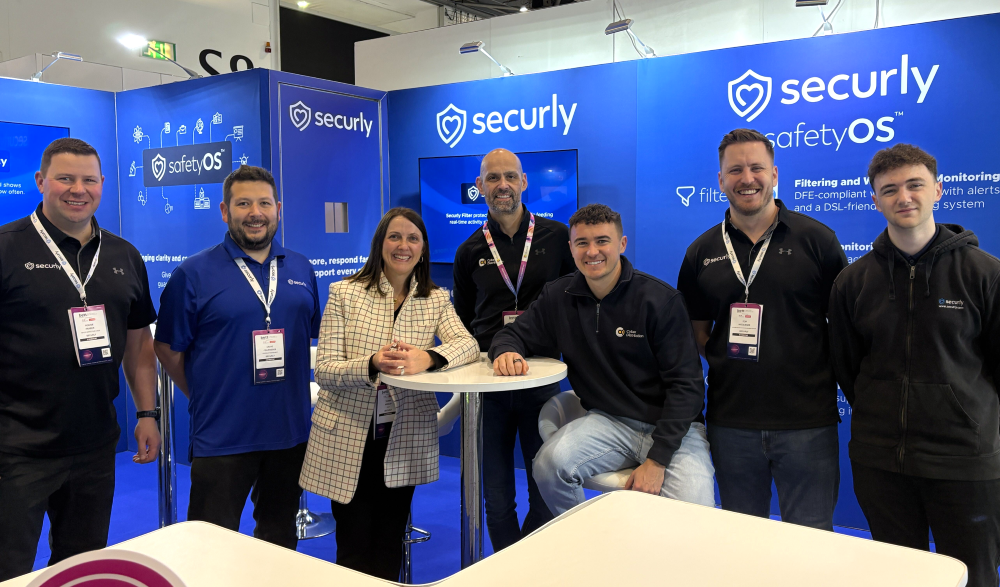
We talk with Tammy Wincup, CEO of Securly — a cybersecurity company exclusively focused on how to help students be safe, well and ready to learn in their digital footprint — about the state of the market and how edtech CEOs can effectively lead in the current climate. You can enjoy engaging insights into these important topics during the CEO Keynote Panel: Strategies for Leading Through Market Uncertainty at the upcoming EdExec Summit, taking place September 10-11 in Chicago.
“You’ve got two polar conversations happening right now in terms of digital safety,” says Wincup. “There is the largest tech revolution that’s ever happened, certainly in my lifetime, across tech around AI with administrators in districts trying to answer, ‘How do we prepare students and teachers?’ On the flip side, you’ve got a conversation happening in the community around using too much tech, with it coming back to a screentime and over-reliance on edtech conversation.”
Wincup, has been a leader in the educational technology realm for 25 years, with previous leadership roles at Rethink Education, Get Well and EVERF. Her current company works with more than 27,000 schools, nearly half of all K-12 schools in the U.S.
“I’ve been in edtech before we called it edtech,” she says. “I think we’re at an interesting period. It is a baseline expectation that we owe our kids, and this clarified to the market is that you need a full operating safety and wellness plan, which cannot be piecemeal.”
Indeed, what used to be a side consideration, now is a main question districts have to ask and answer.

Changing Along With a Changing Market
Part of leading through a shifting economical landscape is finding your place in the big picture and addressing the heart of issues that matter
“We’ve gotten case studies, big districts with a hundred thousand students or more, facing the same challenges as small districts,” Wincup says. “Leading through this landscape falls back to how they operationalize it and how they tell their story to their stakeholders. Whether that’s board, whether it’s parents, whether it’s teachers — we as an industry speak in general policies, but it’s the administrators that actually have to then go make their message clear. Our job is to make sure that they have the tools to be able to execute those policies.”
As mentioned, the screen time debate continues to be a challenge.
“I was just on the phone with a very large school district considering their response and what they want to implement,” Wincup says. “Another smaller district has very masterfully used the data from their kids’ digital footprint to inform teaching and learning. It’s a hard time for districts to balance both an AI revolution at the same time that parents and caregivers and boards are correctly asking, ‘Have we moved too far toward tech?’”
Backing decisions with data is one way to bring parents into the conversation, and to be confident that thoughtful decisions are made about how to use tech in the classroom.
“It’s almost like going back to 2010 when E-Rate and CIPA first came out saying, ‘We want to give funding to school districts to pay for the internet, but we also want to protect students in its use,’” Wincup says. “Those two principles are still wildly relevant. It’s gotten more complicated. Now there are apps, there are tools, there are large language models, et cetera — it requires very sophisticated technology to help districts prepare for that.”
Partnering Toward Success
“Last year there was a lot of polling around how students are using AI,” Wincup says. “We said, ‘Enough asking questions.’ We know what types of prompts and character AI and relationships with AI, etc., are happening. We know that 80% of the millions of prompts we see right now are within the guardrails that districts set.”
Steering the conversation to one that addresses the real issues is key.
“The other 20% are not, so helping districts think through their AI-use policies to keep students safe within that segment is our focus,” Wincup says. “Districts can bring parents and caregivers into the conversation using data from our home app, ‘This is the summary of what your kids did in their digital footprint while they were out of school, while on their school-issued device.’”
Being a good partner to stakeholders starts with information.
“Our job is not to make more noise in a very noisy space. It’s actually to quiet and bring attention to what’s actually happening versus the hypotheses on it.”
Wincup feels education is an industry where the vast majority of people are there for the right reasons. They are there because they fundamentally want to put the student at the center of the conversation.
“Start every conversation, every internal meeting with how does this benefit the student?” she says. “Yes, you have to talk about how it benefits the teachers and administrators. But we have an obligation to start with the students. The education organizations that do that every day are the ones that succeed.”
In Wincup’s opinion, the largest school districts are sometimes where ed companies “go to die.”
“A lot of entrepreneurs start by thinking, ‘I need to be in the largest districts,’” she says. “I find the mid- and small-sized districts and schools are the ones that will pressure-test you and frankly make you great. They are the innovators, the ones doing more with less. Those are incredible administrators and partners with whom you’ll want to work.”
Tammy Wincup: 3 Observations of the Evolution of Edtech
The K-12 tech user and buyer is far more sophisticated. In the early 2000’s, there was a misconception that K-12 weren’t great adopters, and so you could give them average tech. The CTO buyer is one of the most sophisticated vertical buyers out there so their expectation is higher for what providers are providing to them. Setting the bar higher is a good thing for our kids and for education.
It’s a noisier market. K-12 used to be a place where all single-point solutions could bloom. Anybody who had an idea for a feature could find their way. Education, correctly, is now super sophisticated in saying, ‘That’s not good enough.’ Just because you have a great idea of what might help in the classroom, that is not enough.
There is a new reality because of cybersecurity. This idea that technology providers would go directly to teachers and say, “Use my thing,” does not and should not fly anymore because of overall safety and security. This is another area that has evolved for the betterment of our students.
Meeting the Leaders
Wincup believes that the best relationships grow when districts ask for help to solve some of their biggest challenges.
“My hope for the summit is that we will have really robust conversations about the problems we can actually help them solve,” she says. “I’d love to hear and really dive into the big look-around-the-corner challenges that districts are facing, and put it to the larger community with an expectation that we actually help solve them.”
Wincup will be sharing her insights during the EdExec Summit at:
