
We talk with Brittany Miller, Chief Innovation Officer and Executive Director of the Center for Outcomes Based Contracting, Southern Education Foundation about outcomes-based contracts and why they matter for students. You can enjoy Miller’s engaging insights into these important topics during The EdExec Exchange: Critical Issue Roundtable Discussion at the upcoming EdExec Summit, taking place September 10-11 in Chicago.
“We’ve learned over time that in order to develop a strong contract between a district and provider, there is a misconception that the contingent payment is all there is to it,” Miller says. “You can’t simply make part of the money contingent on outcomes and everything will work for kids. First, we must identify who the students are you want to serve and what program is best going to serve those students from the research and evidence base that exists for particular products.”
At the nonprofit Center for Outcomes-Based Contracting, the work is focused on supporting school districts and their service providers with contracting so that a minimum of 40% of payment to the provider is contingent on meeting agreed-upon student outcomes, says Miller.
She adds that the organization provides technical assistance, field insights, research and policy references, such as their policy document on high-impact tutoring, to help the field grow in their practice of outcomes-based contracting. Open-source resources are also available via the website, aligned with standards of excellence developed from research, to move the needle for student learning.
Defining the success outcomes and metrics that are most important for the district, state or student’s individual learning experience is the next step.
“Contingent-outcome payments create a structure for how the contractual agreement will work,” Miller says. “The real power in the work comes with mutual accountability and continuous improvement work. Outlining who is in charge of what elements upfront, before services are delivered, develops a theory of change for implementation that we are contractually committing to across the partnership to achieve those student success outcomes.”
Miller says the actual contract is typically between the district and service provider, or in some cases between the state granting organization and the service provider on behalf of districts, which is a healthier, clearer partnership than a typical instructional services contract.
Both vendors and districts come to Miller’s organization wanting to learn how they benefit from and create these contracts.
“We have a district contract accelerator that districts can enroll in to create a contract, as well as a provider learning series where we help providers understand the model and what their go-to-market strategy can be,” she says.
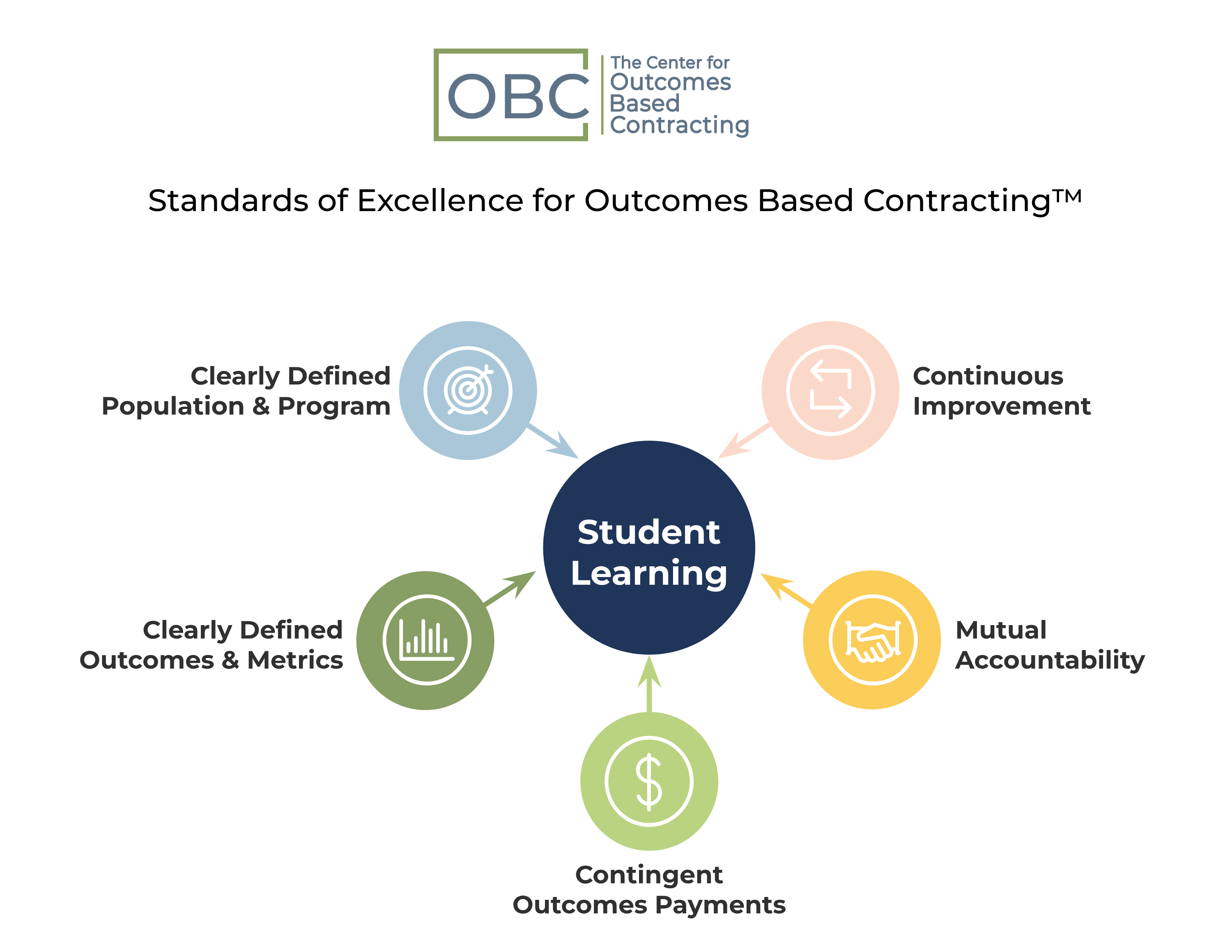
5 Domains Essential to Outcomes-Based Contract Success
- Clearly defined population and program.
- Clearly defined outcomes and metrics.
- Contingent outcomes payments.
- Mutual accountability.
- Continuous improvement.
Dollars and Sense in Edtech Contracts
A real strength of the outcome-based contract model is to increase efficiency and get more bang for the edtech budget buck.
“Our goal is not to lessen the number of dollars going into education,” Miller says. “Education needs to be well-funded, but we are in a tight spot right now in the current market. Now is even more important to make the best use of not only district dollars, but of our most precious resource of all — teacher and student time. That resource is irreplaceable.”
Students only have so much time in the classroom with their teachers, so the question becomes how to use technology in a way that enables stronger teaching and learning to happen in the classroom.
“We want to support what the teacher is already doing,” Miller says. “It’s a real opportunity to make sure that classrooms are using purpose-built education technology instead of consumer-built technologies that aren’t focused on student learning in the same way.”
Outcome-based contracts are a way for providers to differentiate themselves in this current tighter marketplace.
“It makes a big impact to say, ‘We know that our product can be really effective for students, so we’re willing to put our money where our mouth is,’” Miller says. “The reason providers are willing to do this is there are mutual accountability responsibilities on the district side which are also contingent for payment. Districts have to make sure students are using the technology as it was intended, based on provider research.”
This element of the contract leads to much higher rates of usage, which is aligned with the implementation integrity required to achieve successful student outcomes.
“In our first national edtech cohort, we had 69% of contract-enrolled students meet the dosage requirements as recommended by the provider,” she says. “That’s a far cry from the 5% problem we normally see and really speaks to how following recommended guidelines can create more cohesive and successful implementation in classrooms.”
Outcome-Based Contracts and Accountability
One area everyone can agree with is that students deserve the best edtech for their needs.
“The real goal here is to get away from the finger-pointing that happens when contracts go wrong,” Miller says. “We need to delve into being accountable to whom we ultimately intend to serve, which is our students. When you can include clear outcomes with measurement modes and standards-of-excellence elements into the contract on the front end, it creates ideal conditions for students to be served.”
An outcome-based contract lays out the means of arriving at that end goal for all stakeholders.
“Knowing how the accountability metrics work can be a really powerful agent for change,” Miller says. “It translates what the value proposition is into something the whole ecosystem understands. It also proves to be a powerful mechanism when it comes to board approvals for contracts. We’ve started to see providers use this as a proactive strategy in order to make themselves better known in the market. It’s really valuable for school boards who must answer where the dollars went and the outcome questions that are actually much more complex than people assume.”
Perhaps the service provider will only get 60% up front, with the remaining 40% being contingent on meeting agreed-upon outcomes. Either the student outcomes are met and the provider will get paid that full amount, or the student outcomes are not met and the provider will get paid less than that full amount.
“A really common misconception is that it’s all or nothing,” Miller says. “It’s a per-pupil price at the outcome level, with multiple outcomes that every student can achieve. We’re detailed and clear about serving individual students effectively with the technology in the classroom and ensuring the provider is being compensated for each of those outcomes. This personalization de-risks the contract for everybody involved.”
Miller is seeing a massive shift in the tides and stronger contract renewals in places where they are otherwise cutting back.
“Districts can negotiate an outcomes-based contract with their current providers to make sure that they’re still serving students, with a proof point for why it’s important to keep that product in the classroom. It’s much harder to pull that service out of classrooms when they can show the success through data,” she says.
Miller says there’s a lot of interest in the model from districts, providers and the philanthropic community that invests in the classroom.
“What we’re most concerned about is that quality is maintained as the model scales,” she says. “The way to do that is through those standards of excellence.”
